Artificial Intelligence (AI) might sound futuristic and complicated, but at its core, it’s surprisingly similar to how people learn. Instead of thinking of AI as a mysterious “black box,” picture it as a child who learns by experience, practice, and feedback.
Learning From Examples: Like Flashcards for a Kid
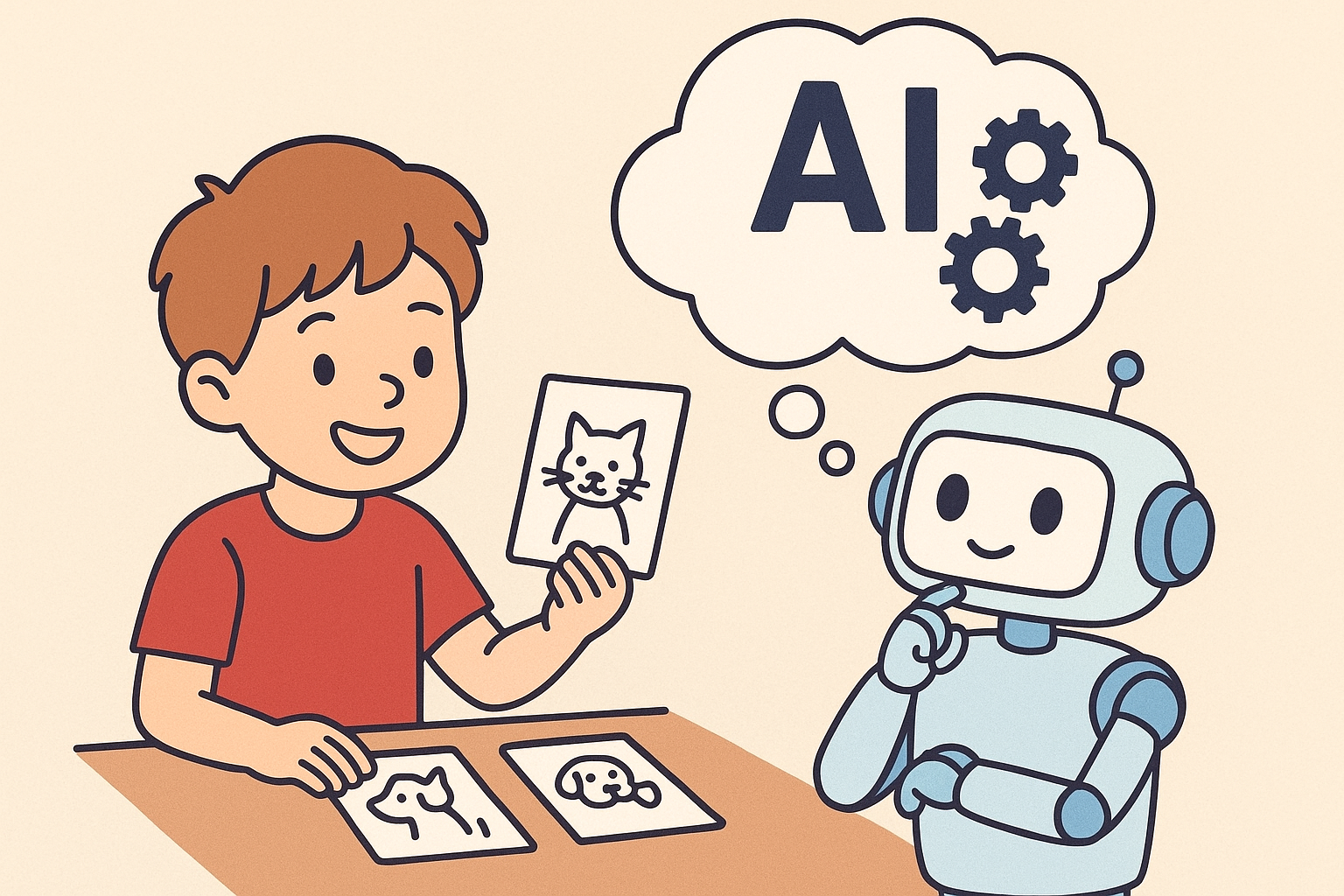
Imagine you’re teaching a child how to tell cats and dogs apart. You don’t hand them a rulebook saying, “cats have whiskers, dogs usually don’t, and tails look different.” Instead, you show them lots of pictures.
Show enough photos of cats → they notice things like pointy ears or certain fur patterns.
Show enough photos of dogs → they notice floppy ears or different shapes.
AI works the same way. Instead of being programmed with strict rules, it looks at thousands (or millions) of examples and figures out patterns on its own.
Algorithms: The Teacher’s Method
If AI is the student, then algorithms are like the teaching methods. Some teachers use repetition, others use games or stories. Algorithms are simply step-by-step instructions that guide the AI in spotting patterns, testing ideas, and improving.
Neural Networks: A Brain Made of Math
When people talk about “neural networks,” think of them as a digital brain made up of layers of little decision-makers.
The first layer looks for basic shapes (edges, colors, sounds).
The middle layers start combining those shapes into objects or words.
The final layer makes a decision: “This is a cat,” or “That word sounds like ‘hello.’”
It’s like a group of kids whispering clues down the line in a game of telephone—each layer adds detail until the final answer comes out.
Practice Makes Perfect: Feedback Loops
Learning doesn’t stop after one try. A child might call a husky a “cat” at first, but when corrected, they adjust their thinking. AI does the same.
During training, AI makes guesses, gets told if it’s right or wrong, and adjusts its “brain connections.” Over millions of tries, it gets better and better—just like practicing piano scales or math problems.
Real-Life Examples You Already Use
AI isn’t some faraway concept—it’s quietly built into tools you use every day:
ChatGPT → Think of it as a super-fast writing partner. Like a friend who’s read millions of books, it can brainstorm ideas, explain things simply, or help you draft an email.
Spotify’s recommendations → It’s like a friend who knows your music taste better than you do, suggesting the exact song for your mood.
Netflix’s suggestions → Imagine a movie-loving buddy who’s always saying, “If you liked that, you’ll love this.”
Google Maps → Like a local guide who not only knows every street but also predicts where traffic will jam before you get there.
Face ID on your phone → Think of it as a bouncer who recognizes your face instantly and only lets you in.
These AIs don’t understand the way humans do, but they’re really good at spotting patterns in your preferences and habits.
What AI Is (and Isn’t) Good At
AI is like a really focused student. It can get amazing at a single subject—like recognizing faces or recommending songs. But it doesn’t understand the world the way humans do.
For example, an AI might beat a world champion at chess, but it can’t tie its shoelaces or understand why you like sunsets. It’s smart in narrow ways, not in general human ways.
Why It Matters
Thinking of AI as a student helps us see both its potential and its limits. It can make life easier—suggesting better routes in traffic, spotting diseases early, or even helping you write emails. But just like a student, it depends on the lessons we give it. If we feed it biased or wrong information, it will “learn” those mistakes too.
Final Thought
AI isn’t a robot overlord—it’s more like a very eager student who never gets tired of practicing. And in many cases, it’s like a helpful friend who knows your habits, preferences, and routines better than you realize. The better we understand how it learns, the better teachers we can be.