Gut Feelings, Déjà Vu, and the Mystery of the Mind: Is Consciousness Ahead of Time?
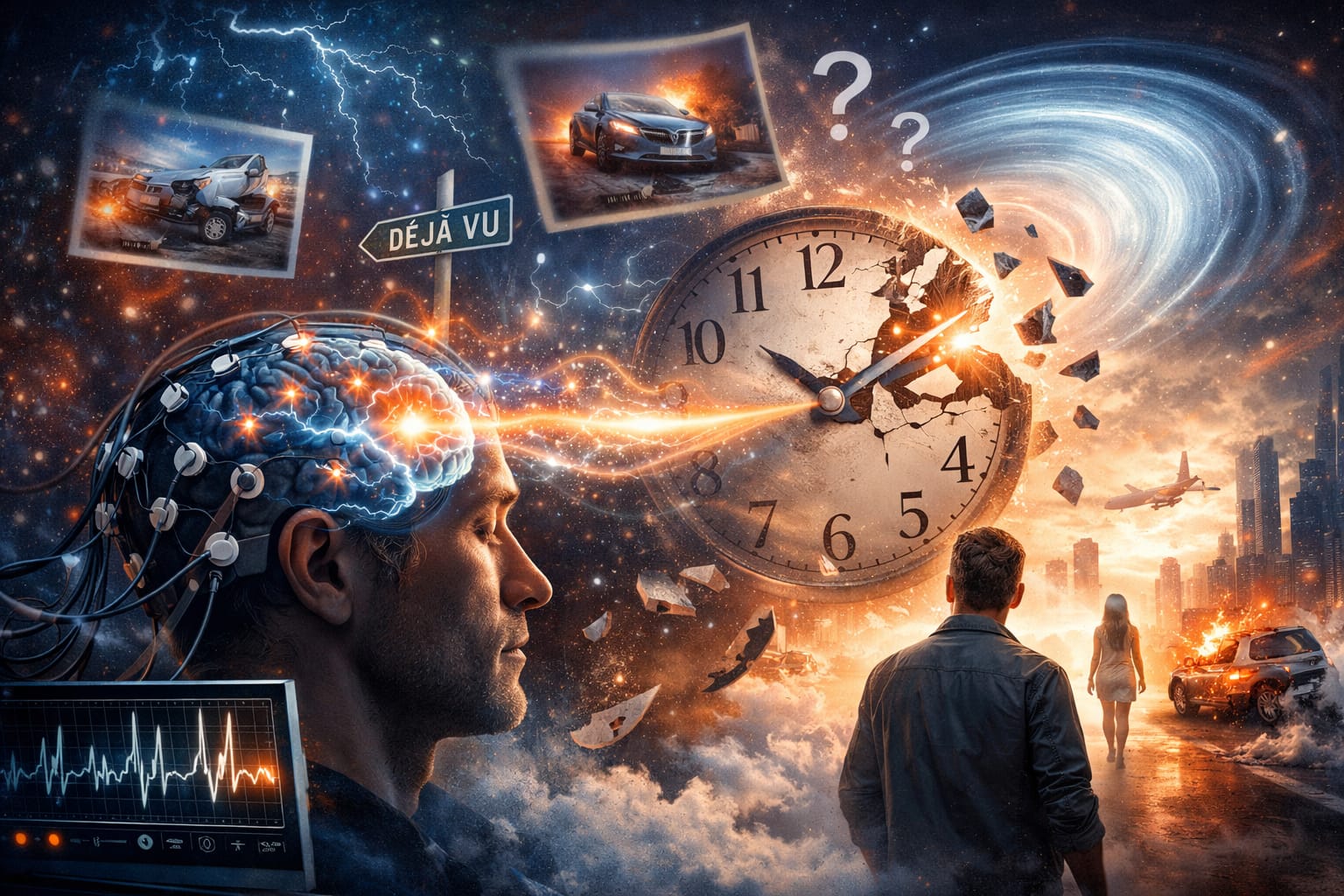
Most people have experienced it at least once—a sudden gut feeling, an unexplained sense of familiarity, or a moment of déjà vu that feels too vivid to ignore. Traditionally, these experiences are explained as memory errors or coincidence. But emerging research suggests something far more intriguing: the human brain may sometimes respond to future events before they happen.
Recent studies in neuroscience and psychology have examined a phenomenon known as precognition, where individuals appear to sense upcoming events without conscious awareness. In tightly controlled laboratory experiments, participants were exposed to random images while their brain activity was monitored.
The results were unexpected.
EEG recordings showed measurable changes in brain activity several seconds before participants viewed emotionally negative images. At the time, they had no information about what image was coming, yet their brains reacted in advance—as if anticipating the future.
What Is an EEG Test?
An EEG (Electroencephalogram) measures the brain’s electrical signals through small electrodes placed on the scalp. These signals reflect communication between neurons. EEG tests are commonly used in medical settings to diagnose neurological conditions such as epilepsy and seizure disorders. In research studies, EEGs allow scientists to detect subtle, moment-to-moment changes in brain activity that are invisible to conscious awareness.
Challenging the Flow of time, these findings raise a profound question: is consciousness limited to the present moment, or does it operate beyond linear time?
Traditional neuroscience assumes the brain reacts only after information is received. However, these experiments suggest that the brain may process information in a non-linear way—responding to events before they fully unfold.
Some researchers propose that the brain may rely on quantum-like processes, allowing it to integrate information across time rather than in a simple cause-and-effect sequence. While still theoretical, this idea could explain moments of intuition, sudden insight, or accurate decisions made without any logical explanation.
Are Gut Feelings Signals from the Future?
If consciousness can access information ahead of time, gut feelings may not be random guesses. Instead, they could be unconscious responses to future emotional or environmental cues. These signals may surface as instincts, unease, or an unexplainable sense of certainty—processed by the brain long before conscious reasoning catches up.
If validated, this research could reshape how we understand memory, perception, and awareness itself. The clear boundary between past, present, and future would blur, suggesting that the mind experiences reality as a more fluid continuum.
Rather than acting only as a receiver of information, the human brain may function as a predictive system—quietly reaching forward in time. Déjà vu, intuition, and gut feelings may be glimpses into this hidden capacity.
The possibility remains controversial, but one thing is clear: consciousness may be far more complex—and far less confined by time—than we once believed.